Case Study: Fintech
We worked on validating a new business idea in the Purchase Order Financing space and here’s a run down of what that process looked like.
Here’s all the background you need to dig into this one: when a brand is looking to manufacture products with a contract manufacturer, they need to pay the invoice for that production run long before they ever get the revenue from selling the finished goods. This causes a cash flow challenge for them and there is a large market for financial products that solve this problem, from standard loans, to cash advances on future sales, among others.
We anchored around their Goals
First we worked with the team to identify their goals. Among other things, we heard that they wanted to create a high growth technology business funded by venture capital and they wanted to minimize regulatory and compliance obligations of the business as much as possible.
Knowing these goals impacted our validation strategy significantly. For example, because they were aiming to build a high growth business, we knew that validating the revenue potential and market size early on would be critical. Another example: because minimizing regulatory obligations was important to them, we incorporated a validation conversation with a lawyer early on as well.
We got explicit about their Hypotheses
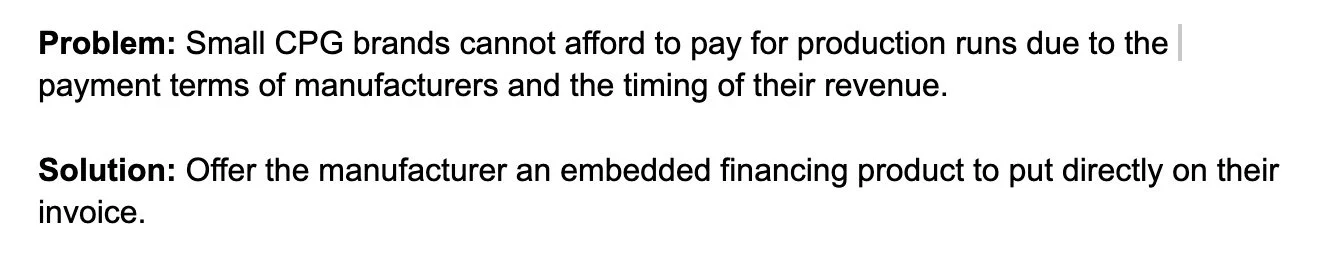
The team came to the table with a solid understanding of the space through prior work with brands and manufacturers as well as research into existing financing options. From this foundation, they had starting hypotheses about the customer, need, and solution. Here’s a bit of what we helped them articulate:
We mapped out their assumptions
Its can be hard to identify your own assumptions as an entrepreneur because you know your space well and may take a lot for granted - since we are likely not industry experts in your space, we’re in a great position to ask lots of questions and help you tease out your assumptions.
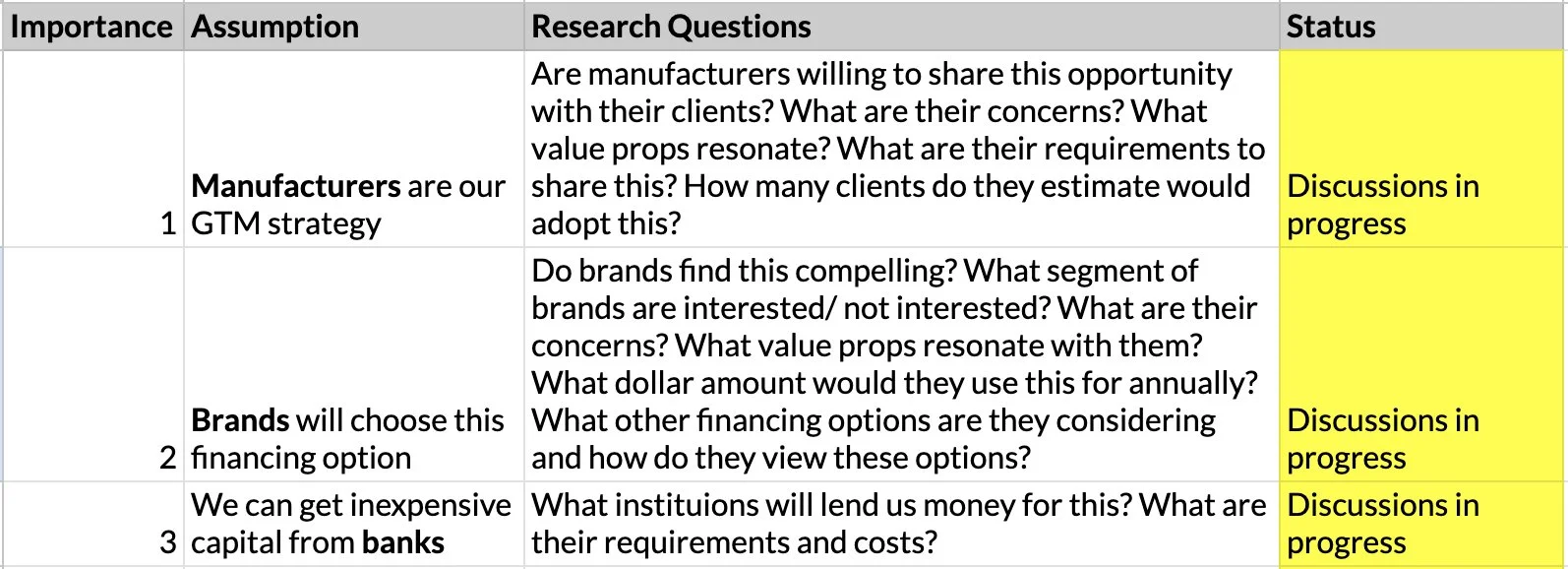
We started by asking this team, “why do you think this is a good idea?” and kept digging from there. We put up a ton of post-its with all of their assumptions, then asked them to tag the assumptions that absolutely had to be right for their business to work. Now that we had this subset, we asked them to order the assumptions by how risky they were. All along the way, we kept questioning, challenging, and digging deeper.
Here’s a snippet from the Assumption Map we created:
We created a testing plan
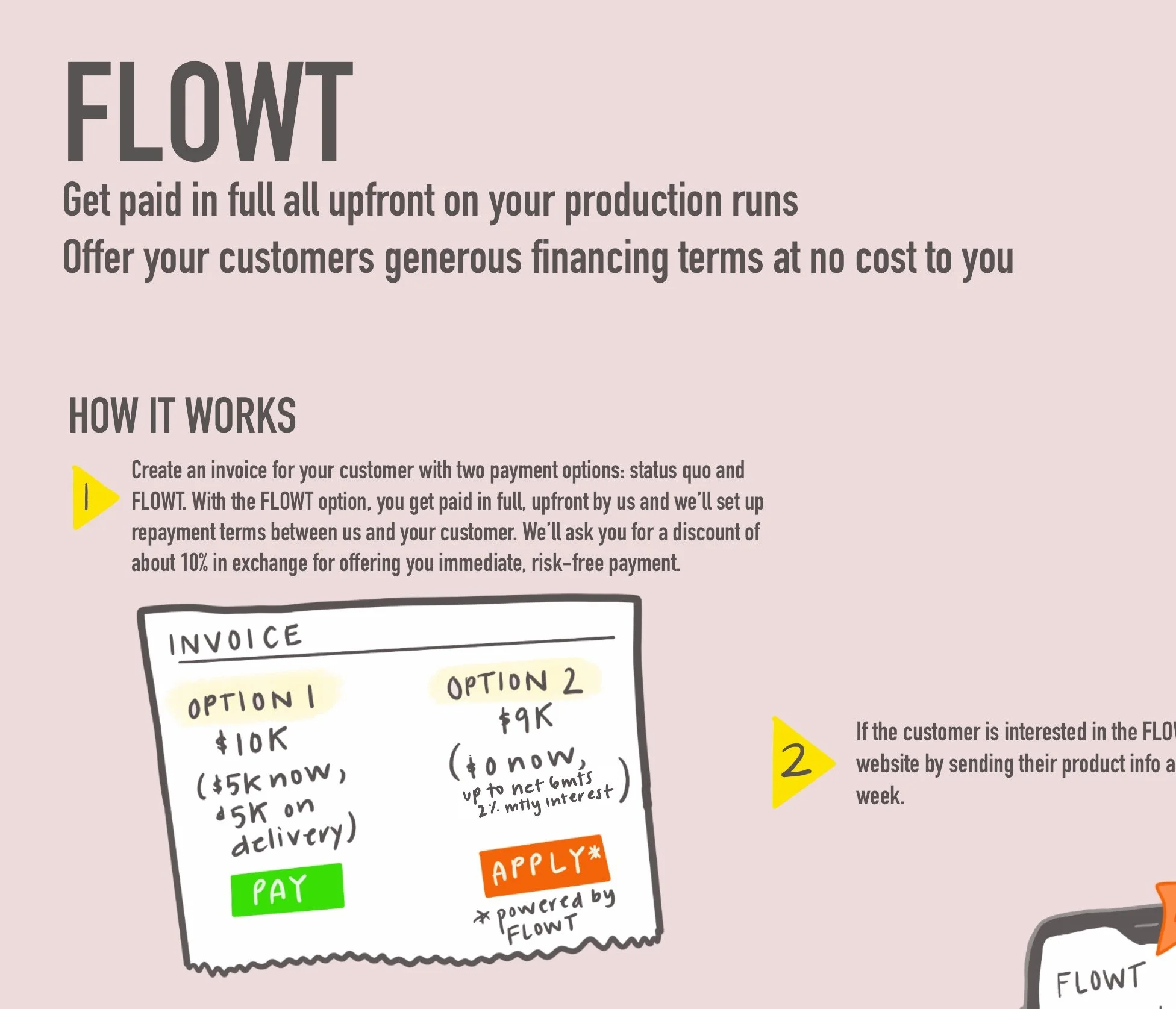
To test our first assumption, we first made a list of all of the contract manufacturers that we could access. We thought about the questions that we wanted to ask to really drill into our assumption that they would distribute a financing product, and then created a Sell Sheet (like a one page summary) for our potential product that we’d ask them to react to at the end of the conversation.
Sell Sheets are one of our favorite testing tactics - this is a clip of the one we created for this project:
After our first three conversations, we paused to regroup - we learned that (a) our Sell Sheet was confusing and we needed to make some edits (b) we were talking to manufacturers who were too big and should refocus on smaller ones. The next round of interviews were even more helpful as a result of stopping to iterate.
In total, we spent 4 weeks testing and pulled in a range of tactics specifically chosen for our assumptions. For example, we found a start-up that did something similar and talking to their founder who had since exited, we asked brands to stack rank hypothetical financing options we put in front of them, and much more.
We wrapped up with Insights
We had been checking in with the team every week to share insights and working with them to iterate on their idea as a result of what we were learning. Every time they iterated on the idea, we also edited the assumptions map, and the testing plan. At the end of the month, we had a summary to share with them of the assumptions we tested, the tests we ran, what we learned, and our confidence level. Here’s the first row of our Assumptions Scorecard:

We talked through all of the learnings with them and pulled back up their goals — based on everything we now know, do they still think this is a good idea to accomplish their goals? The answer in this case was no (or yes if they were willing to compromise on some of their goals, like the short timeframe to test and fundraise or the VC-scale of the business). Ultimately we were all not confident that the most important assumption underpinning the idea was true.
We brainstormed pivots and felt confident that there was a potential solution that would result in a small business for the founders, but since that their goal was to build something high-growth, we ruled that out.
The founders had set aside 4 weeks to validate this idea and felt confident that it was thoroughly explored and invalidated. They had no shortage of ideas, so they decided it was time to move on to the next one!